elusive wordsmith

The Lifespan of a Concept

Published on September 21, 2026

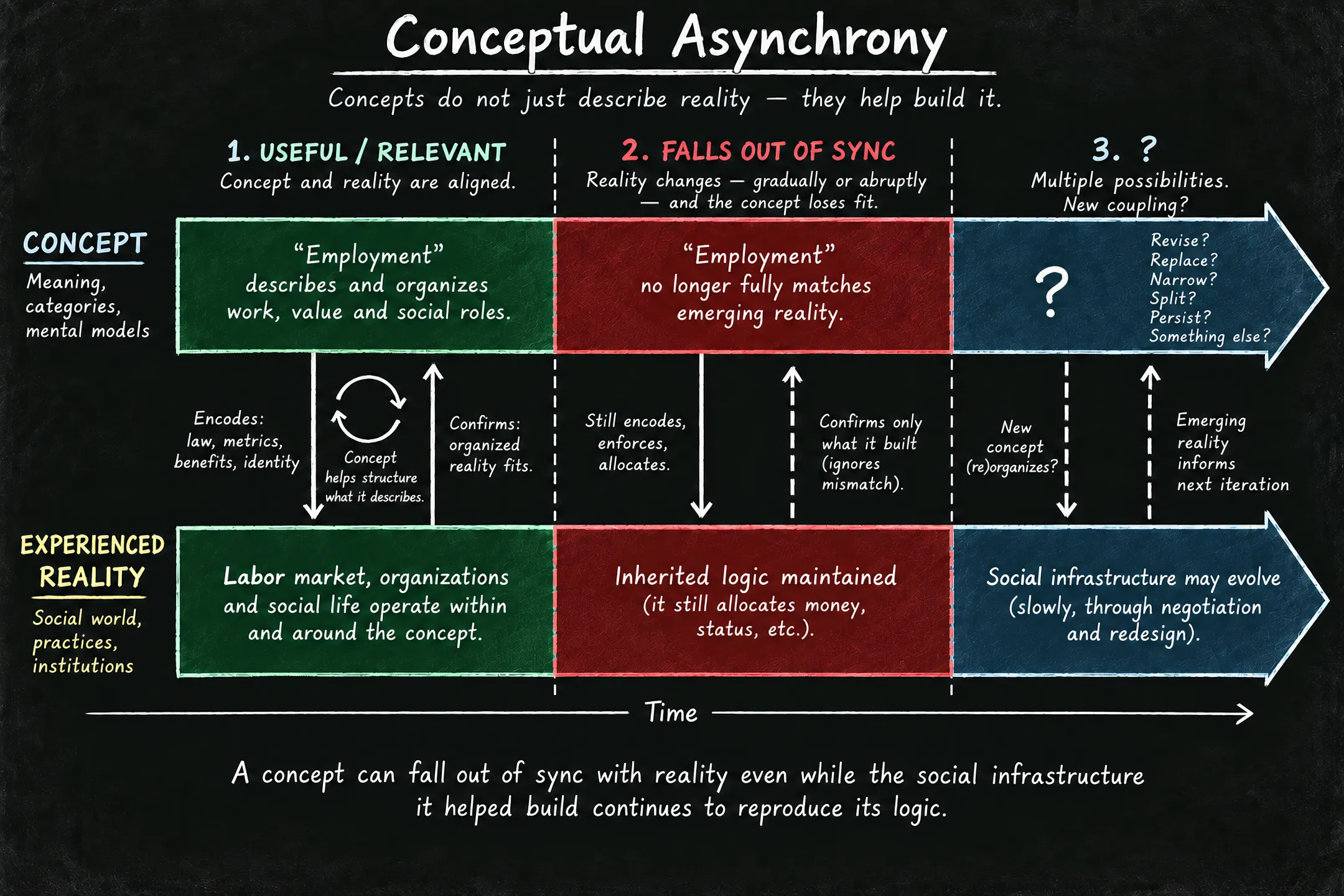
Chalkboard-style diagram titled "Conceptual Asynchrony", subtitled "Concepts do not just describe reality — they help build it." Two horizontal lanes move through three phases along a shared time axis. The upper lane, "Concept" (meaning, categories, mental models), follows the concept "Employment". Phase 1, "Useful / Relevant" (green): concept and reality are aligned — "Employment" describes and organizes work, value and social roles. Phase 2, "Falls out of sync" (red): reality changes, gradually or abruptly, and the concept loses fit — "Employment" no longer fully matches emerging reality. Phase 3, "?" (slate): multiple possibilities, a potential new coupling — Revise? Replace? Narrow? Split? Persist? Something else? The lower lane, "Experienced Reality" (social world, practices, institutions): in phase 1, the labor market, organizations and social life operate within and around the concept; in phase 2, inherited logic is maintained — it still allocates money, status, etc.; in phase 3, the social infrastructure may evolve, slowly, through negotiation and redesign. Arrows between the lanes show the coupling: in phase 1, the concept encodes law, metrics, benefits and identity and helps structure what it describes, while organized reality confirms the fit; in phase 2, the concept still encodes, enforces and allocates, but the return signal is dashed — reality confirms only what the concept built and ignores the mismatch; in phase 3, dashed arrows suggest a new concept may (re)organize reality while emerging reality informs the next iteration. A caption reads: "A concept can fall out of sync with reality even while the social infrastructure it helped build continues to reproduce its logic."
(Illustration: gibru / Licensed under: CC-BY-SA 4.0)